 230 views
Why Solving LeetCode 3163: String Compression III in C++ is Important?
LeetCode 3163, String Compression III, is more than just a coding challenge—it's a practical exercise in C++ string manipulation and algorithmic thinking that mirrors real-world data compression and text processing tasks.
Key Skills Developed
Efficient String Handling in C++: Learn to traverse and compress strings without exceeding memory limits, a common requirement in performance-sensitive applications.
- Edge Case Management: Handle scenarios where character sequences exceed the maximum allowed count, ensuring robustness in your LeetCode 3163 solution.
- Algorithm Optimization: Implement linear-time string compression algorithms that efficiently process large datasets.
Real-World Applications
Data Compression: Understand the principles behind string compression algorithms in C++, applicable in file storage and transmission.
- Text Processing: Optimize text data for storage or transmission by reducing redundancy.
- Algorithm Design: Enhance your ability to design efficient string optimization algorithms.
Interview Relevance
Top tech companies often assess candidates with challenges like LeetCode String Compression III. Mastery of these C++ string problems demonstrates strong analytical skills and readiness for technical interviews.
Understanding LeetCode 3163: String Compression III Problem
In LeetCode 3163: String Compression III, we are asked to compress a string by replacing consecutive repeated characters with a count followed by the character. One important detail is that the count cannot be greater than 9, so longer sequences need to be split properly.
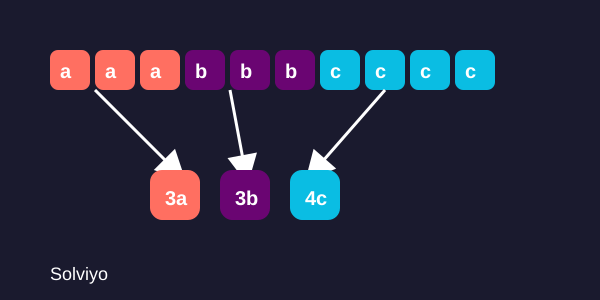
For example, given the input "aaabbbcccc", we can compress it like this:
- 'a' occurs 3 times →
"3a" - 'b' occurs 3 times →
"3b" - 'c' occurs 4 times →
"4c"
So the final output becomes "3a3b4c".
The string will only contain lowercase English letters, and the goal is to compress it efficiently without exceeding the count limit of 9.
I found this problem interesting because it really makes you think about iterating through the string carefully and handling edge cases where the counts reach the maximum allowed.
Step-by-Step Approach and Logic Explained
My approach to this problem was to iterate through the string while keeping track of consecutive characters and their counts. The tricky part is making sure that the count never exceeds 9, which means sometimes I need to "split" a long sequence into multiple groups.
Here’s the step-by-step logic I followed:
- Initialize an empty string
resto store the compressed result and a countercntset to 1. - Start iterating from the second character (index 1) of the string.
- For each character:
- If it is the same as the previous character and the count is less than 9, increment
cnt. - If it is different from the previous character or
cntreaches 9, appendcntfollowed by the previous character toresand resetcntto 1.
- If it is the same as the previous character and the count is less than 9, increment
- After the loop ends, append the last counted character and its count to
res. - Return the final compressed string
res.
I also made sure to think about edge cases, such as strings with only one character or long sequences exceeding 9, to make sure my logic handles everything correctly.
C++ Implementation for LeetCode 3163 Solution
Based on the logic I described, here’s the C++ solution I implemented for this problem:
class Solution {
public:
    string compressedString(string word) {
        string res = "";
        int sz = word.size(), cnt = 1;
        for (int i = 1; i < sz; i++) {
            if (word[i] != word[i - 1] || cnt == 9) {
                res += cnt + '0';
                res += word[i - 1];
                cnt = 1;
            } else {
                cnt++;
            }
        }
        res += cnt + '0';
        res += word[sz - 1];
        return res;
    }
};
I wrote this code carefully to handle both the cases where characters repeat less than 9 times and where they repeat more than 9 times. The cnt == 9 condition ensures that we never exceed the allowed count per group.
Alternative Approaches and Optimizations
While the primary solution for LeetCode 3163: String Compression III in C++ uses a simple counting loop to group characters and limit each group to 9, there are other ways to implement this logic efficiently. Below are a few alternative approaches and small optimizations that can make your code faster and more memory-friendly.
1. Using a String Builder (ostringstream)
Instead of repeatedly concatenating strings, which can be inefficient, you can use std::ostringstream or a std::string buffer to append compressed parts more efficiently. This minimizes reallocation and improves runtime, especially for long strings.
class Solution {
public:
    string compressedString(string word) {
        ostringstream res;
        int sz = word.size();
        for (int i = 0; i < sz; ) {
            char current = word[i];
            int cnt = 0;

            while (i < sz && word[i] == current && cnt < 9) {
                i++;
                cnt++;
            }

            res << cnt << current;
        }

        return res.str();
    }
};
2. Preallocating the Result String
If the input length is known and large, you can reserve memory for the output string using result.reserve(s.size()). Although the compressed string may be shorter, this prevents multiple memory reallocations during appends.
3. Vector-Based Compression
For extremely large datasets, using a std::vector to first store character–count pairs and then building the final string in one pass can improve performance and maintain code clarity.
4. Handling Continuous Groups Over 9
A small optimization is to directly calculate how many groups of 9 you’ll need when a character repeats many times. Instead of manually looping and resetting counters, you can divide the count and append results in fewer iterations.
5. Clean Code Improvements
- Use
forloops instead ofwhilewhere iteration is predictable. - Extract the compression logic into a helper function for reusability.
- Leverage
constexpror inline helper methods to reduce runtime overhead.
These optimizations don’t drastically change the algorithm’s complexity (it remains O(n)), but they can enhance readability, maintainability, and real-world efficiency. Always benchmark before applying micro-optimizations.
Step-by-Step Walkthrough
Let me explain how my code works using an example input: "aaabbbcccc".
- Initialization: Start with an empty string
res = ""and a countercnt = 1. - Iteration: Begin traversing the string from index 1:
- Compare each character with the previous one.
- If it matches and
cnt < 9, incrementcnt. - If it doesn't match or
cnt == 9, appendcnt + previous charactertoresand resetcnt = 1.
- Finalization: After the loop, append the last character and its count to
res.
For the input "aaabbbcccc":
- 'a' occurs 3 times → append "3a"
- 'b' occurs 3 times → append "3b"
- 'c' occurs 4 times → append "4c"
Final compressed string: "3a3b4c"
This step-by-step approach helped me ensure the code works for all edge cases, including sequences longer than 9 and strings with single characters.
Time & Space Complexity Analysis
After implementing the solution, I wanted to check how efficient it is:
Time Complexity
The code iterates through the string once, processing each character in constant time. Therefore, the time complexity is O(n), where n is the length of the input string.
Space Complexity
I use a separate string res to build the compressed result. In the worst case (no compression), res could be roughly the same length as the input, so the space complexity is O(n).
Overall, this solution is very efficient for strings of any reasonable length.
Common Mistakes and Edge Cases in String Compression III
cnt variable after appending a group to the result string. If you miss this, the count will carry over to the next character group.cnt++ in the wrong place can cause off-by-one errors in the output. Make sure you only increment when the character is the same as the previous one.9 for each run, even if there are more repeating characters. This keeps the compressed format valid and prevents issues with multi-digit counts.Sample Input & Output
To make it easier to understand, here’s a sample input and how the output looks after compression:
| Input | Compressed Output | Explanation |
|---|---|---|
| "aaabbbcccc" | "3a3b4c" | 'a' occurs 3 times → "3a" 'b' occurs 3 times → "3b" 'c' occurs 4 times → "4c" |
| "aaaaaaaaaa" | "9a1a" | Count cannot exceed 9, so sequence of 10 'a's is split into "9a1a". |
| "abc" | "1a1b1c" | No repeated characters, so each character is represented with count 1. |
Conclusion: Key Takeaways from Solving LeetCode 3163 in C++
Solving LeetCode 3163: String Compression III was a great exercise in string manipulation and careful iteration. It taught me to pay attention to edge cases, especially when sequences of characters exceed the maximum allowed count of 9.
The key takeaways from this problem are:
- Always handle edge cases like long sequences or single characters.
- Use a counter carefully and reset it at the right time.
- Think about time and space efficiency; this solution works in O(n) time.
I encourage you to try variations of this problem or explore the related string compression challenges. Practicing these problems will strengthen your understanding of string processing and algorithmic thinking.