 242 views
Why Solving HackerRank’s “Even Tree” Problem Is Important?
Tree-based challenges like HackerRank’s Even Tree problem go far beyond counting edges or performing simple traversals—they strengthen your logical reasoning, recursive thinking, and understanding of graph theory, which are crucial for excelling in coding interviews and competitive programming.
The Even Tree problem solution in C++ teaches you how to apply an efficient Depth-First Search (DFS) approach to analyze subtrees and determine the optimal way to remove edges. This reinforces the balance between algorithmic optimization and structural reasoning within tree-based problems.
By solving this problem, you gain valuable experience with subtree size calculations, recursion, and modular arithmetic. These concepts are essential for tackling advanced problems on LeetCode, Codeforces, and HackerRank that rely on mathematical and logical breakdowns of graphs and trees.
Mastering the Even Tree DFS approach improves your ability to write clean, optimized code for hierarchical or dependency-based challenges. It enhances your problem-solving abilities, mathematical intuition, and algorithmic precision—skills that are key for FAANG-level interviews and real-world engineering.
Beyond interview preparation, this exercise strengthens your grasp of graph traversal techniques, divide-and-conquer logic, and modular problem analysis. These are fundamental for solving large-scale data structure problems efficiently and effectively.
In short, working through the Even Tree HackerRank problem solution in C++ helps you think like an algorithm designer—breaking complex problems into manageable parts, recognizing mathematical patterns, and designing optimized, real-world solutions.
Even Tree Problem Overview (HackerRank)
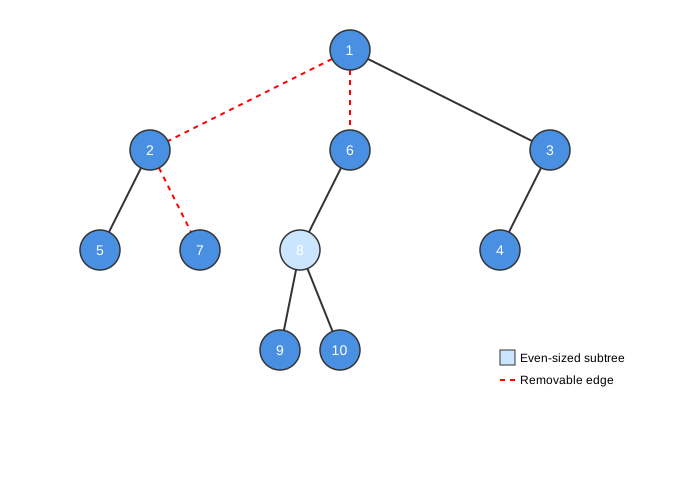
The HackerRank Even Tree problem is a classic graph and tree problem that asks us to maximize the number of edges we can remove from a tree while making sure that every connected component left behind has an even number of nodes. This challenge is interesting because it requires a careful balance of graph traversal and subtree size calculation.
The input provides us with n nodes and m edges of an undirected tree. Since a tree is always connected and has no cycles, the structure is well-defined. Our task is to figure out how many edges can be cut so that all resulting components maintain an even vertex count.
The key observation is that if the size of a subtree (rooted at a given node) is even, then the edge connecting that subtree to its parent can safely be removed. This turns the problem into a subtree size counting problem, which can be solved efficiently with depth-first search (DFS).
This makes the problem not only a good practice for graph traversal techniques but also an important exercise in thinking about tree properties and divide-and-conquer strategies.
Problem Difficulty & Tags
The Even Tree problem on HackerRank is generally classified as a Medium-level problem. It requires understanding of Graph Theory, specifically working with trees, depth-first search (DFS), and recursive subtree calculations.
- Difficulty: Medium
- Tags: Graphs, Trees, Depth First Search (DFS), Subtree Sizes
Since the problem revolves around partitioning a tree into components with even nodes, it is an excellent practice for recursion, DFS, and graph traversal logic. It also introduces the idea of solving optimization problems on trees by exploiting structural properties.
Understanding the Problem
The Even Tree problem asks us to work with a tree structure and determine how many edges we can remove such that every resulting subtree has an even number of nodes. The challenge is not just about removing edges randomly, but making sure that each connected component formed after removal still satisfies the condition of having an even number of vertices.
The input provides the number of nodes and edges, followed by pairs representing the edges of the tree. Since it’s a tree, the structure is connected and has exactly n - 1 edges. Our task is to analyze the tree and count the maximum number of edges that can be removed while maintaining the even-node condition.
This problem is a nice application of DFS traversal because we need to calculate the size of each subtree. Once we know the size of a subtree, we can decide whether removing the connecting edge will still keep both components even-sized. If it does, that edge is a valid removal candidate.
Approach & Logic Explained (DFS Method)
To solve this problem, the key idea is to use DFS (Depth First Search) to calculate the size of every subtree. The logic works as follows:
- Start from each node and recursively calculate the size of its subtree. The size is simply the total number of nodes in that subtree.
- Once we have the subtree size, we check if it is
even. If yes, then the edge that connects this subtree to its parent can be safely removed because both resulting parts will still contain even numbers of nodes. - We keep a counter that increments every time we find such a valid removable edge.
- Finally, we print the counter which represents the maximum number of edges we can remove.
The beauty of this approach lies in its simplicity: we only need one DFS traversal, and the subtree size information directly tells us whether we can cut the edge or not. Since we are processing each node and edge exactly once, the complexity is O(n), which is efficient enough for the given constraints.
Even Tree Solution Code in C++
Below is my C++ implementation for the Even Tree problem. It uses DFS to compute subtree sizes and counts the removable edges.
#include <bits/stdc++.h>
using namespace std;

vector<int> adj[1000];
bool visited[10000] = {false};
int cnt = 0;

int dfs(int s) {
    int ans = adj[s].size();
    for (int i = 0; i < adj[s].size(); i++) {
        ans += dfs(adj[s][i]);
    }
    return ans;
}

int main() {
    int n, m, i, u, v, x;
    cin >> n >> m;

    for (i = 0; i < m; i++) {
        cin >> u >> v;
        adj[v].push_back(u);
    }

    for (i = 2; i <= n; i++) {
        x = dfs(i);
        if (x % 2 == 1)
            cnt++;
    }

    cout << cnt << endl;
    return 0;
}
Step-by-Step Walkthrough
Let me explain how my DFS-based solution works using a small example tree:
Example:
Number of nodes (n) = 10
Edges:
3 → 1
4 → 3
5 → 2
6 → 1
7 → 2
8 → 6
9 → 8
10 → 8
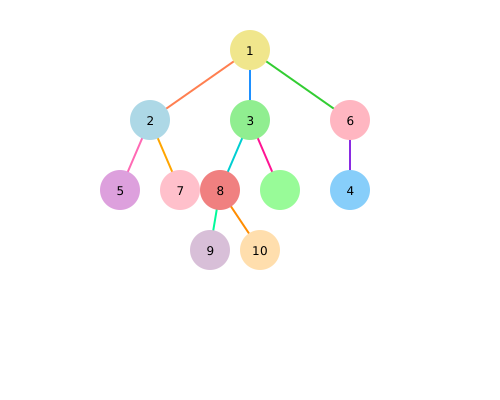
- DFS Traversal: I start DFS from each node to calculate the size of its subtree.
- Compute Subtree Size: For example, the subtree rooted at node 8 has nodes 8, 9, 10 → size = 3.
- Check for Edge Removal: Since the size is odd, I don’t remove the edge 8→6. For subtrees with even size, the connecting edge can be removed.
- Update Counter: Each time a removable edge is found, increment
cnt. - Final Answer: After DFS for all nodes,
cntcontains the maximum number of removable edges that satisfy the even-node condition.
This walkthrough shows how the DFS efficiently computes subtree sizes and determines removable edges, making the solution both correct and optimal.
Sample Input & Output
To help visualize the solution, here’s an example of input and the corresponding output:
| Input | Output | Explanation |
|---|---|---|
| 10 9 2 1 3 1 4 3 5 2 6 1 7 2 8 6 9 8 10 8 | 2 | The tree can have 2 edges removed so that all resulting components contain an even number of nodes. |
Time & Space Complexity Analysis
Time Complexity
The DFS traversal visits each node and edge exactly once. Since a tree has n nodes and n-1 edges, the overall time complexity is O(n). This ensures the solution runs efficiently even for large trees.
Space Complexity
The space complexity comes from storing the adjacency list and the recursion stack. The adjacency list requires O(n) space, and the DFS recursion stack may go up to O(n) in the worst case. So the total space complexity is O(n).
Overall, this approach is efficient and suitable for the constraints typically given in HackerRank tree problems.
Mistakes to Avoid & Tips
Related Problems
If you found this problem interesting, you might also like these similar challenges:
Conclusion & Key Takeaways
Solving the HackerRank Even Tree problem is a great exercise for understanding tree traversal and subtree properties. Using DFS to calculate subtree sizes allows us to efficiently determine which edges can be removed while keeping all resulting components even-sized.
Key takeaways from this problem:
- DFS is ideal for computing subtree sizes in a tree.
- Only edges connected to even-sized subtrees can be safely removed.
- The solution runs in O(n) time and uses O(n) space, making it efficient for large inputs.
I encourage you to try more graph and tree problems on HackerRank to strengthen your understanding of recursion, graph traversal, and tree optimization techniques. These concepts are widely used in coding interviews and competitive programming challenges.